No Fear, No Retreat, No Surrender
Masked men, fake police cars, and anonymous threats won’t break us. Wake Forest is organized, watching, and unafraid.


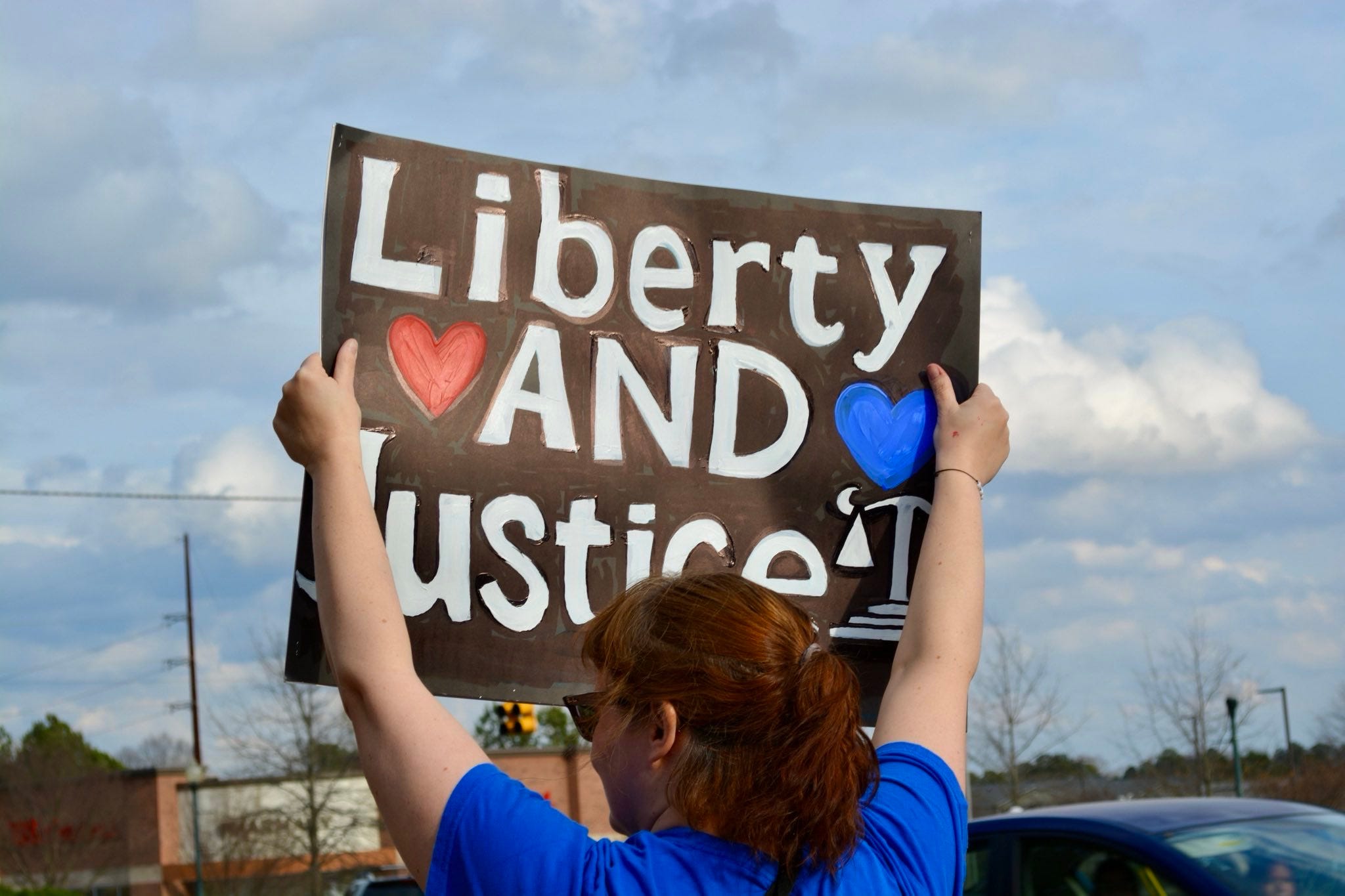
This past weekend, the true spirit of Wake Forest was visible on the sidewalks at the intersections along Main Street, including at Ligon Mill, Rogers Road, and 98 Bypass. Over 100 residents gathered each day, the largest group on sidewalks in the public right of way in front of Wake Forest Middle School, joining a nationwide wave of over 1,000 events under the banner of “ICE Out For Good.”
Wake Forest Indivisible organized this lawful, two-day mobilization not just to advocate for policy, but to mourn. They gathered to honor Renee Nicole Good, a 37-year-old wife and mother of three who was murdered by an ICE agent in Minneapolis.
From the start, the organizers prioritized safety, legality, and direct communication with the Wake Forest Police Department. We spoke with resident Jen Amyx, the lead organizer who works in conjunction with the Town to ensure their events are noticed and lawful. Amyx stated that she “communicated directly with Captain Zick at the Wake Forest Police Department, who handles the picketing notices we file when planning at least 48 hours in advance.”
While notice of intent to picket isn’t required when responding to real-time events, it is a good idea to inform the town liaison as a courtesy. That is the kind of collaboration we need between citizens and our local government.
Amyx also highlighted the community’s remarkable response to the call for action. “We announced the weekend protests on Friday, but had over a hundred protestors each day, in spite of only 24 hours notice,” she noted.
It is important to note the intergenerational nature of the event. The group that answered that call was diverse, composed of young families with their kids and dogs, young adults, professionals, and business owners. They stood alongside many elderly Wake Forest residents, some of whom were standing tall using the aid of a walker or cane. Amyx emphasized that the event was designed to be respectful and disciplined, explicitly rejecting the inflammatory tactics used by some groups.
In doing so, the Wake Forest crowd directly honored the wishes of Renee Good’s wife, Becca Good, who released a statement asking supporters to focus on Renee’s legacy of kindness.
“We honor her memory by living her values,” she wrote. “Rejecting hate and choosing compassion, turning away from fear and pursuing peace, refusing division and knowing we must come together to build a world where we all come home safe to the people we love.”
But while residents stood in the light to honor a life taken by violence, a coordinated campaign of local intimidation attempted to drive them into the shadows.
The Weapon of Choice: A Tactical Analysis
The intimidation campaign was spearheaded by a specific vehicle: a black 2011 Ford Crown Victoria Police Interceptor (P71) with North Carolina tag TLB-9889.
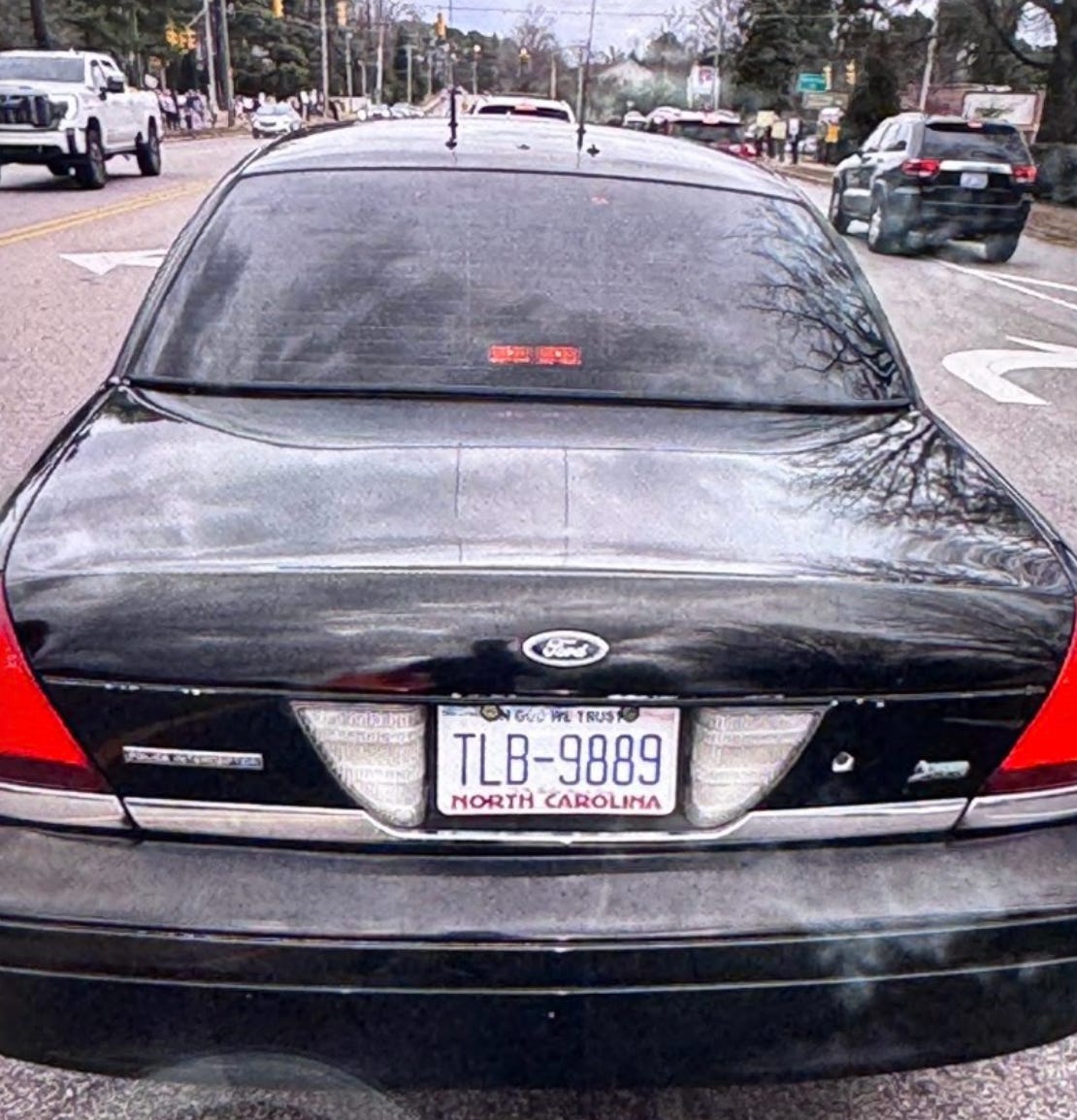
Video analysis confirms this is not a standard civilian car. It is a decommissioned police package refitted with law enforcement features. It is distinct from the civilian “LX” model, featuring standard-issue 17-inch black steel wheels with chrome center caps, a lack of chrome trim on the door handles, and characteristic dual exhaust.
Most critically, the vehicle retains the “upfitter” equipment of a patrol car. A spotlight is mounted on the driver’s side A-pillar, and the windows are heavily tinted, a tactic common in K-9 units or private security to conceal the occupants. The license plate is a standard civilian tag, indicating this is a privately owned, decommissioned unit. The owner has not just bought a used car; they have maintained a “ghost cruiser,” refitted to project false authority.
This reliance on “technological asymmetry” or using equipment that civilians do not possess to project dominance has a dark precedent in this state. In 1898, before the Wilmington Massacre, white supremacists mounted a Gatling gun on a horse-drawn wagon and paraded it through Black neighborhoods. The message then was the same as the message sent by the P71 Interceptor: We possess the machinery of state violence, and we are watching you.
Video evidence captured on Rogers Road in front of Wake Forest Middle School confirms the driver utilized the vehicle’s PA system.
We must be clear about who is at risk when this rhetoric hits our streets. In North Carolina, 58.5% of all hate crimes are motivated by race, with Black residents remaining the primary target. When a vehicle like this patrols our streets shouting slurs, it is contributing to a statistical reality where hate crimes and white supremacist propaganda are currently surging by over 30% in our state.
The Man Behind the Wheel
We now know that this intimidation was not a random occurrence, but the latest escalation by a known actor with a documented history of police impersonation and weapons charges.
Public records identify the owner of the vehicle as Amaury Nathaniel Santos (who goes by “Nathan”), a 24-year-old resident of Wake Forest. Santos resides at a property owned by his father.
We reached out to the elder Santos via email to ask if he was aware that a vehicle registered to his home and engaging in extremist behavior was being stored on his property. As of 5:00 PM today, he has not responded to our request for comment.
While Nathan Santos attempts to project an image of authority on our streets, his criminal record reveals a pattern of dangerous instability:
A History of Impersonation: On August 21, 2023, Amaury Nathaniel Santos was charged in Wake County with Impersonating Law Enforcement (Case #9102023034228CR). This confirms that Santos has previously crossed the line from “enthusiast” to active impersonator. That same day, he was also charged with Reckless Driving with Wanton Disregard, further establishing a willingness to use his 4,000-pound vehicle as a weapon of intimidation.
Weapons Involvement: Just one month before his impersonation charge, on July 16, 2023, Santos was charged with Carrying a Concealed Gun (Case #9102023028052CR). We are not dealing with a peaceful counter-protester; we are dealing with an individual who has a history of carrying concealed weapons while role-playing as a police officer.
Obsessive Concealment: Santos’ commitment to his “ghost cruiser” persona borders on obsession. Public records indicate that between June 2022 and January 2025, he has been charged with illegal window tinting violations no fewer than 14 times. Despite repeated citations, he refuses to comply with safety standards to maintain the ability to survey the community while remaining hidden.
The Lesson of 88 Seconds
We cannot view these modern caravans in a vacuum. We have a blood-stained precedent right here in North Carolina. On November 3, 1979, the distance between a “rolling protest” and a death squad was measured in seconds—88 of them, to be exact.
The Greensboro Massacre, carried out by Neo-Nazis and members of the KKK, transformed from a caravan to a mass shooting in an instant. When the City of Greensboro finally issued its apology in 2020, it wasn’t just for the violence; it was for the absence of protection. The police knew the route. They knew the actors. They knew the weapons. But they treated it as a parade right up until the moment it became a slaughter.
I am not accusing the Wake Forest Police Department of complicity. However, I am reminding our leadership that history judges what you don’t do just as harshly as what you do. Passive observation of extremist caravans, especially those driven by individuals with active records of impersonation and weapons charges, is a gamble with public safety that our state has already lost once. We don’t need to lose it again.
The Mechanized Siege
The vehicle is also equipped with a functioning PA system, with the 100-watt speaker likely mounted behind the grille. Video evidence captured on Rogers Road confirms the driver utilized this system to amplify hate speech. As the vehicle passed the First Watch restaurant, the driver explicitly shouted: “White Power!”
This auditory assault is a direct revival of tactics used in Monroe, NC, during the 1950s. During that era, KKK motorcades would drive through targeted neighborhoods with engines racing and horns blaring, creating a wall of sound designed to penetrate the walls of homes and businesses.
On Saturday, the Crown Vic acted as a “probe,” stopping in the road to use its PA system to shout racist slurs and threaten protesters. On Sunday, the siege escalated. The Crown Vic returned, leading a convoy that included a lifted white pickup truck and a red sedan.
This was not the behavior of confused motorists; it was the behavior of tactical actors echoing the “Red Shirts” of 1898, who organized 1,000 men on horseback to attack Wilmington’s multi-racial government and community, or the “Catfish” Cole KKK caravans of 1958. The modern convoy flanked the mourners, with the driver of the white pickup performing a stiff-armed Nazi salute and screaming “White Supremacy.” Bringing up the rear, the red sedan weaponized its weight, swerving toward the sidewalk and then driving off in a game of chicken played with a 3,000-pound projectile against unprotected pedestrians.
Driving Out the Extremist Element
However, North Carolina history also teaches us that vehicular intimidation has a breaking point. When a community is organized and fearless, the “motorcade” loses its power.
On January 18, 1958, KKK Grand Dragon James “Catfish” Cole attempted to use these exact tactics against the Lumbee Native American community in Robeson County. Cole led a convoy of Klansmen to a rally at Hayes Mill Pond (often called the “Battle of Maxton Field”), expecting to cow the locals into submission with cross burnings and amplified speeches.
But the Lumbee community did not hide. Hundreds of armed Lumbee men surrounded the Klan’s position. The Klansmen were outnumbered by a unified community, and they panicked. They fled into the swamps, abandoning their vehicles, their regalia, and their “authority.”
The victory was complete and public. The Lumbee victory party began soon after and continued late into the night. They took the captured PA system back to Pembroke, where they celebrated outside the police station by hanging and burning an effigy of Cole. But the most powerful blow was symbolic.
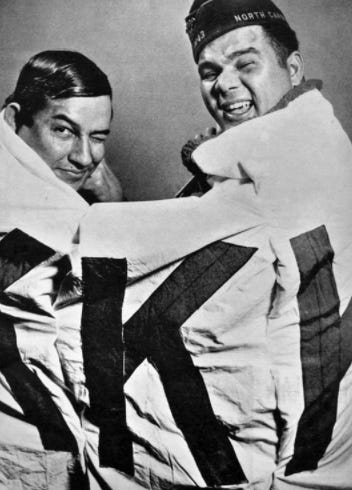
Two Lumbees, Charlie Warriax and Simeon Oxendine, a WWII veteran and son of the mayor of Pembroke, took the captured KKK banner and drove 140 miles to Charlotte. They entered the offices of the Charlotte Observer around midnight to ensure the story was told on their terms.
Oxendine, holding the captured symbol of hate, delivered a line that shattered the Klan’s mystique:
“This Ku Klux banner is mine, and I’m going to walk into the lobby of the Charlotte Hotel wearing it like a scarf.”
A photograph of Warriax and Oxendine carrying the banner around their shoulders became the dominant image of the victory, proving that when a community stands together, the intimidators are not only defeated, they are stripped of their power.
The lesson of Maxton Field is not about violence; it is about PRESENCE. Catfish Cole was driven out of Robeson County because the community refused to be fragmented. Extremist elements rely on the assumption of fear and isolation. When they are met with organized, collective resistance, their power evaporates.
The Price of Standing: Direct Retaliation
The intimidation did not end when the sun went down. Erica Vogel, founder of Be Like Missy, stood on the corner of Rogers and Main, refusing to cede the sidewalk to the Crown Vic driver. We reached out to Vogel for comment after seeing a post on her business Facebook page mentioning the vehicle.

Because she stood her ground, the aggression followed her home. This transition, from public street to private home, is the hallmark of the “Night Rider.” From the Klan’s attack on the home of Essie Harris in 1871 to the assault on Dr. Albert Perry in the 1950s, the goal of the mobile patrol has been to violate the sanctuary of the domestic sphere.
On Sunday at 6:48 PM, Vogel received a chilling text message from a local number containing her home address and a direct threat:
![A screenshot of a text message received on a smartphone at 6:48 PM from a number with a 919 area code. The text reads: "This is your notice to stop. Further communication will be handled in person at [Address Redacted]? Do you lock your doors at night?"](https://substackcdn.com/image/fetch/$s_!C-Fk!,f_auto,q_auto:good,fl_progressive:steep/https%3A%2F%2Fsubstack-post-media.s3.amazonaws.com%2Fpublic%2Fimages%2F655ee235-76d1-4553-b9c3-1a97e6ce28dc_818x564.png "A screenshot of a text message received on a smartphone at 6:48 PM from a number with a 919 area code. The text reads: \"This is your notice to stop. Further communication will be handled in person at [Address Redacted]? Do you lock your doors at night?\"")
The harassment escalated rapidly. Less than twenty minutes later, at 7:06 PM, Vogel’s husband received a second, more graphic message from the same number. Shifting from vague warnings to explicit misogyny and implied violence, the text read:
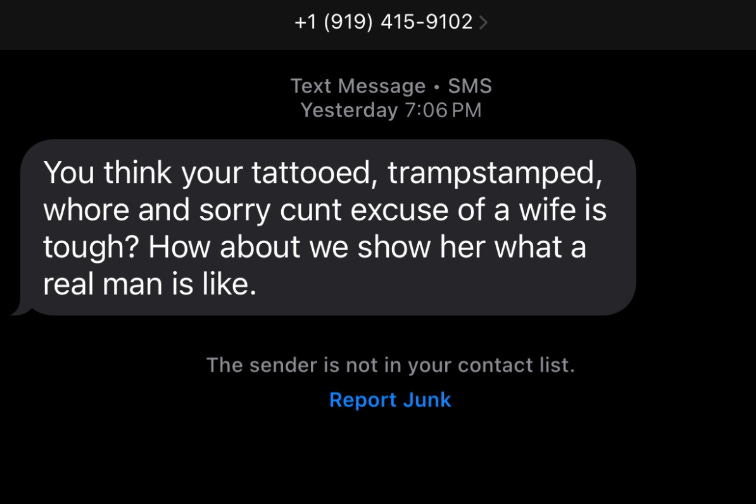
This fits a disturbing pattern. Since the publication of the vehicle’s license plate, other residents have come forward to confirm that this same driver has harassed them at their private homes in the past. The targeted coordination against both Vogel and her husband suggests this is not random road rage, but a concerted effort to silence community members through fear, a modern digital version of the burning cross.
Voices of Resistance
Despite the threats, the women of Wake Forest’s business community remain unbowed.
Amanda Cottrill, owner of True You Studio, was among those standing on the corner. For her, the mobilization was about visibility and basic human decency in the face of national rhetoric.
“The protests remind all of us that when we come together, we can make a change for what’s right and we aren’t alone,” Cottrill said. “Renee Good didn’t deserve what happened to her, and she deserves to be remembered via action... I won’t be silent, and I won’t stop fighting for human decency.”
A Duty to Stand
The contrast could not be starker. On one side, we have masked men in a fake police cruiser performing Nazi salutes and sending anonymous threats. On the other hand, we have local women unmasked, visible, coordinating with the Town, and holding the line.
To the community: The question “Do you lock your doors at night?” was meant to terrify one woman and her family. But it should wake up an entire town.
We do not call for violence, but we do call for presence. We call for the watchful eyes of neighbors and the solidarity of friends. This is how we keep one another and our families and town safe.
We can surrender our neighborhoods to the ghosts of our state’s past, or we can answer the call of small business owners like Vogel and Cottrill. We can stand together to ensure that those who try to bring darkness to Wake Forest are met with a blinding, immovable light.
I love the way you integrate history into your analysis, Tom. I always learn so much and it provides such important perspective,.